The Work Vehicles That Pay Themselves Off Faster
If you run deliveries, trades, fleets or small businesses in South Africa, your vehicles are not just transport, they’re tools that either make you money or drain it. You feel that every time the petrol price ticks up and your monthly fuel bill quietly eats more of your profit.
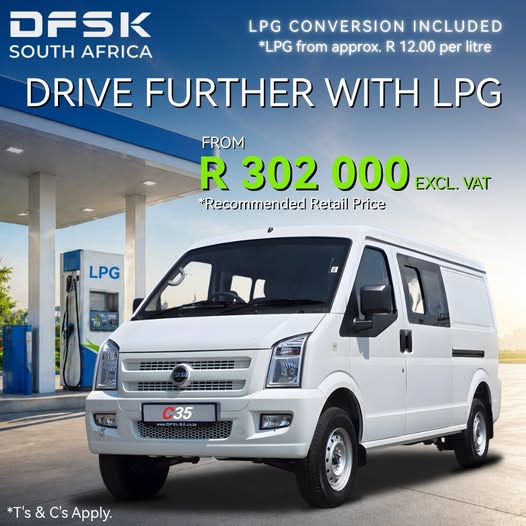
That is exactly where DFSK’s petrol commercial range, combined with DFSK‑approved LPG Autogas conversions, changes the game.
Is LPG Really Worth the Hassle for My Business?
Most buyers’ first thought is: this sounds clever, but is it worth the admin and change?
The short answer is: yes, if you care about cost per kilometre and uptime more than badge prestige.
- LPG (and so LPG cars in South Africa) is consistently cheaper per litre than petrol in South Africa, with typical 30–50% savings on fuel in many commercial use cases.
- For delivery fleets and high‑kilometre operators, that often translates into a payback period of roughly 6–18 months, depending on mileage and pricing.
- After that, the savings compound for the rest of the vehicle’s life.
DFSK’s core petrol workhorses, the C35 panel van / crew bus and K01S bakkie are built around simple, naturally aspirated engines and rear‑wheel‑drive load capability. That makes them ideal bases for LPG (Liquefied Petroleum Gas), reliable, easy to service nationwide and designed to work hard rather than impress in a showroom.
Will I Lose Performance or Range?
This is usually the second big concern. Let’s be blunt, if the vehicle feels weak or range‑limited, the savings don’t matter because the job doesn’t get done.
Engine and performance
Both the C35 and K01S use proven, naturally aspirated petrol engines with multipoint fuel injection, 1.5L (85 kW / 148 Nm) in the C35 and 1.2L (65 kW / 115 Nm) in the K01S. In standard petrol form they are already tuned for balanced power under load, not racing, and owners report consistent performance at full payload on both urban and highway routes.
LPG systems are calibrated to work with these engines, and the feedback is clear, customers may feel only a minimal difference in power, with smooth operation and no interruption when the system changes between fuels. For most delivery and trade use, the performance impact is negligible in day‑to‑day work.
LPG conversion range, the part most buyers underestimate
This is where LPG can actually give you more flexibility, not less:
- The standard petrol tanks (around 40–55 litres depending on model) remain in place.
- LPG conversions add toroidal (donut) tanks or cylinder tanks, typically 48L donut tanks for space‑sensitive applications, or up to 90L cylinders for maximum range.
- This point is important: cylinder tanks allow larger LPG capacities, giving high‑mileage fleets significantly extended range between refueling stops, and they are combined with the existing petrol tank. One can also add long range tanks, which is perfect for Courier companies!
The end result is a dual‑fuel vehicle with two energy sources and a total usable range that often exceeds the standard petrol‑only setup.
What Happens If the Gas Runs Out?
This is the question many buyers are too embarrassed to ask.
The DFSK‑approved system is designed for drivers who just want to get on with their day:
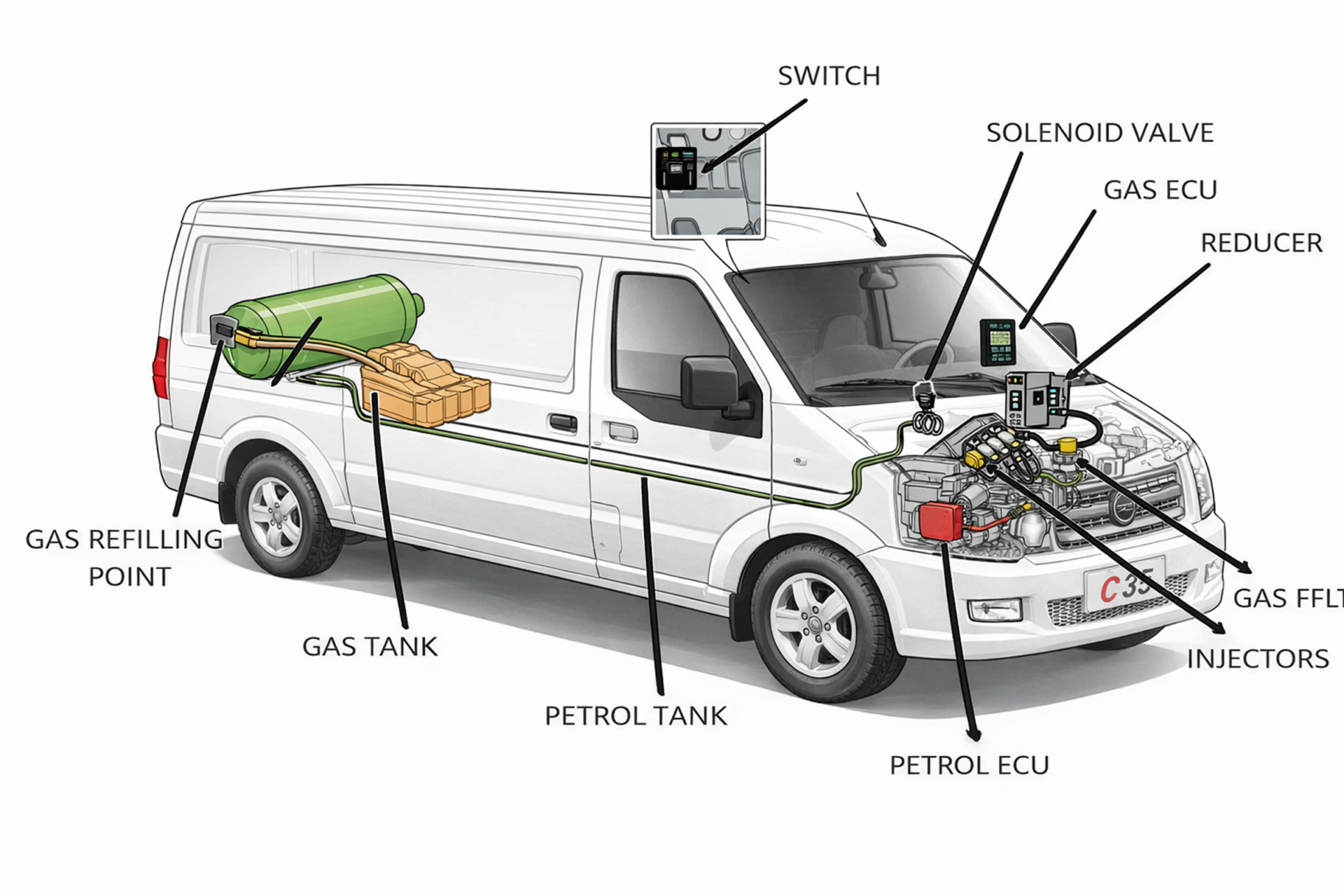
- The engine always starts on petrol and automatically switches to LPG once it’s up to temperature.
- If the LPG tank runs low, the system automatically switches back to petrol with no stall or drama, the driver keeps going.
- A simple dashboard switch and clear colour indicators show whether the vehicle is currently running on LPG (green) or petrol (red), with four‑level LED indicators for LPG fuel level.
So even if a driver misjudges LPG range or arrives at a site without a nearby LPG point, the vehicle simply continues on petrol. There is no downtime, only a temporary loss of the fuel‑saving advantage until the next LPG fill.
Am I Losing Space or Practicality in the Van or Mini Truck?
Serious fleet buyers ask about payload and cargo volume, not just tank sizes.
At DFSK we anticipate this objection directly:
“Customers will ask: Am I losing space with a DFSK LPG conversion? Your answer: No, the gas tank uses unused space where the spare wheel normally sits. The spare is simply moved and secured properly in the load area.”
Key points:
- On C35 and K01S conversions, the LPG tank uses space under the vehicle where the spare wheel would normally sit.
- The spare wheel is relocated into the cargo area with a secure mounting and cover, keeping it out of the way and protected while still accessible.
- Payload figures remain in the same ballpark: up to 800 kg in the 2‑seater C35 and around 985 kg in the K01S bakkie, which are strong numbers for their class.
In most real‑world deliveries, the limiting factor is weight before volume. The conversion is designed to preserve the full working ability of the vehicle while adding LPG capacity.
Is LPG Really Safe – or Am I Adding Risk?
Safety perceptions can kill deals faster than facts. DFSK and its Autogas partners are acutely aware of this.
The LPG system is packed with safety features that don’t exist in typical “DIY” conversions:
- Automatic gas cut‑off in an accident – the system shuts off gas flow instantly under abnormal pressure or impact.
- Pressure safety valves manage internal tank pressure and isolate gas if the tank is damaged.
- The system is sealed and fully enclosed, minimising exposure to external elements compared with traditional fuel systems.
- LPG only ignites under specific air‑fuel conditions, just like petrol, it cannot simply “catch fire” in the tank.
- Tanks are filled to a maximum of 80% capacity by design, allowing for gas expansion and further reducing pressure risk.
In practice, regulated LPG systems with certified components and installation standards can be as safe, or in some scenarios safer, than conventional petrol fuel systems.

Will This Mess With My Warranty or Resale Value?
Any smart buyer or fleet manager asks this early, and they should.
We position our LPG car conversion as a DFSK‑approved upgrade, not a backyard modification:
- Conversions are done through recognised partners with systems matched to DFSK engines.
- When fitted according to DFSK South Africa’s standards, the vehicle’s 5‑year / 100,000 km warranty remains in place for the base vehicle, with LPG‑specific components supported through the conversion network.
- Because LPG burns cleaner than petrol, the training manual notes less carbon build‑up, longer engine life and reduced maintenance needs, all of which are positives for residual value.
Compared with unapproved aftermarket modifications that can void warranties, staying inside the DFSK programme keeps your risk controlled and your resale story clean.
Questions Buyers Often Don’t Think to Ask (But Should)
1. “What is my actual monthly fuel spend per vehicle and what would LPG save me in rand terms?”
Most businesses know they’re spending “a lot” on fuel but don’t know the number. DFSK’s dealer guide explicitly tells sales teams:
“Ask: What’s your monthly fuel spend? How many vehicles? Break it down per vehicle… You’re not buying a vehicle. You’re stopping a leak in your business.”
If your bakkie or van is burning, say, R7,000–R10,000 a month in petrol, shifting a large portion of that to LPG can save thousands of rands per month per vehicle once the conversion is paid off. That changes profit margins more than a small discount on the purchase price.
2. “How much does downtime cost me compared with the cost of the conversion?”
A C35 or K01S is built to be a “business tool on wheels” not a toy. The engines are simple, non‑turbo designs precisely because they are easier and cheaper to maintain over time.
Now add dual fuel, even if LPG infrastructure or pricing shifts, you still have petrol as a full backup. Fleet uptime is therefore less dependent on a single fuel source, which reduces the risk of vehicles standing due to one supply issue.
3. “Which tank configuration actually matches my routes?”
Not every user needs the biggest LPG tank available. Lets look at it simply:
- Toroidal (donut) 48L tanks – best for space‑sensitive urban deliveries and lighter routes.
- Cylinder tanks up to 90L – best for high‑mileage fleets and longer corridors where range between fill‑ups matters more than every cubic centimetre of space.
For the right customers, a cylinder tank gives more gas on board and therefore more total range, especially when you add the existing petrol tank.
Why DFSK + LPG Is a Particularly Strong Combination
A lot of brands can “do LPG.” What makes DFSK’s proposition compelling is how tightly the vehicles and conversion philosophy are aligned.
- The C35 is pitched as “a business tool on wheels” – a practical van for couriers, SMEs, trades and fleets, with up to 800 kg payload and over 5 m³ of cargo space in 2‑seater form.
- The K01S is called an “entry‑level business weapon” – a compact dropside workhorse with nearly a ton of payload and low running costs for start‑ups, small contractors and informal traders.
Both are:
- Simple, non‑turbo petrol engines.
- Rear‑wheel drive for stability under load.
- Designed around payload, uptime and low maintenance.
Layer LPG on top and you get:
- Lower cost per kilometre.
- Extended range with larger LPG tanks plus petrol backup.
- Dual fuel redundancy.
- Warranty protection, when done through DFSK’s approved programme.
- A cleaner‑burning fuel that helps engines stay healthier for longer.
For a South African business buying with its head, not its ego, that’s a powerful story.
The Bottom Line
You’re Not Just Buying a Vehicle – You’re Plugging a Leak
Calculate your solution, talk money and solve the pain you have every month.
If you’re considering a DFSK C35 or K01S for your business, the real question is not “petrol vs LPG” or “panel van vs bakkie.” It’s:
- How much am I really spending on fuel every month?
- What would dual fuel and lower cost per kilometre do for my cash flow and profit over the next 5 years?
Once you have those numbers, the decision usually becomes much clearer.